Lecture 1: Data Exploration
 HTML Slides
 PDF Slides
Welcome to Machine Learning!
COMP 4630 | Winter 2026 Charlotte Curtis
What is this course about?
- Continuing the supervised/unsupervised learning algorithms from COMP 3652, with a focus on Neural Networks
- First half: the history, theory, and math behind neural networks
- Second half: applications of NNs in computer vision, natural language processing, and more
This is not (just) a course on building models using libraries like TensorFlow or PyTorch, it is a course on understanding the theory
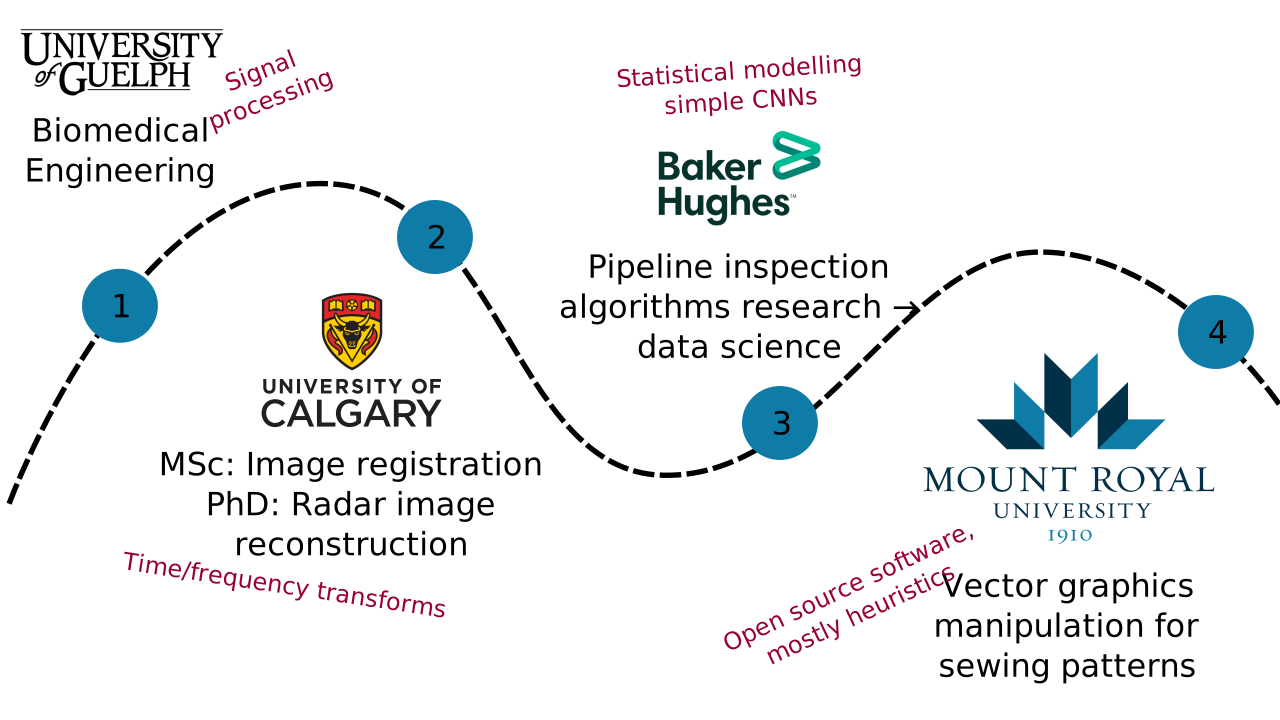
How did I get involved with ML?
What do you want to learn about ML?
❓
Grade Assessment
| Component | Weight |
|---|---|
| Assignments | 3 x 10% |
| Midterm (theory) exam | 20% |
| Journal club | 10% |
| Final project | 40% |
Bonus marks may be awarded for substantial corrections to materials, submitted as pull requests
Course materials repo: https://github.com/mru-comp4630/w26 Rendered at: https://mru-comp4630.github.io/w26/
Textbooks and other readings
Primary Textbook:
- Hands on Machine Learning with Scikit-Learn and [Tensorflow/PyTorch]
- Associated GitHub repo (Tensorflow)
- Associated GitHub repo (PyTorch)
More mathy details:
Journal club list: on D2L under “Course Info” (requires MRU library login)
Generative AI policy
- Yes, AI can do a lot of what I’m asking for in this course
- No, I do not want to read about what AI “thinks”
- ❓ What do you think is an appropriate use?
Machine Learning Project Checklist
Appendix A of the hands-on textbook
- Frame the problem and look at the big picture.
- Get the data.
- Explore the data to gain insights.
- Prepare the data to better expose the underlying data patterns to Machine Learning algorithms.
- Explore many different models and short-list the best ones.
- Fine-tune your models and combine them into a great solution.
- Present your solution.
- Launch, monitor, and maintain your system.
1. Look at the big picture
Example Dataset: California housing prices (1990)
❓ Discussion questions:
- How does the company expect to use and benefit from this model?
- What is the current solution?
- What kind of ML task is this?
- What kind of performance measure should we use?
Where we left off on Wednesday, January 7
First, some stuff about assessments
- Assignment 1
- Journal club guidelines
- Example of a math-heavy paper
- Additional references for papers:
2. Get the data
For this class, we’ll use readily available datasets. Some sources are:
- UCI Machine Learning Repository
- Kaggle
- Google Dataset Search
- Various Government open data portals (e.g. Calgary, Alberta, Canada)
After fetching the data, set aside a test set and don’t look at it.
“Get the data” can often be a huge task in itself!
2a. Set aside a test set
❓ Discussion questions:
- Why do we need an independent test set?
- Avoid data snooping bias
- Relevant XKCD
- Why would we use a random seed?
- What is naive about simply selecting a random sample?
- What else could we do?
- What is stratified sampling?
Side tangent: Sampling bias
- Simple example: assume 80% of population likes cilantro
- Goal: ensure our sample is representative of the population,
The binomial distribution can be used to model the probability of choosing people who like cilantro from total participants:
Side tangent: Sampling bias continued
is the probability mass function, and the corresponding cumulative distribution function is just the sum up to :
Suppose we randomly sample 100 people. What is the probability of fewer than 75 or more than 85 cilantro lovers?
This is also my excuse to review some probability theory and notation
3. Explore the data
❓ Discussion questions:
- What do you notice about the data?
- Do the values make sense for the labels?
- Is the scale of the features comparable? Does this matter?
- What possible biases might be present in the data?
3a. Look for correlations
The Pearson correlation coefficient is a measure of the linear correlation between two variables and (commonly denoted as ):
where and are the sample means of and , respectively.
- What do correlations of 0, 1, and -1 mean?
- What are some limitations of Pearson correlation?
Where we left off on Monday, January 12
4. Prepare the data
General goals:
- Handle missing data, and maybe outliers
- Drop irrelevant features
- Combine features using domain knowledge
- Apply various transformations (e.g. scaling, encoding)
- Apply scaling when necessary
4a. Handling missing data
In the book 3 options are listed to handle the NaN values:
housing.dropna(subset=["total_bedrooms"], inplace=True) ## option 1
housing.drop("total_bedrooms", axis=1)                  ## option 2
median = housing["total_bedrooms"].median()             ## option 3
housing["total_bedrooms"].fillna(median, inplace=True)
❓ Discussion questions:
- What is each option doing?
- What are the pros and cons of each option?
- Which one should we choose?
4b. Handling non-numeric data
Most of the math in ML algorithms is based on numbers, so we need to convert text and categorical attributes to numbers. This is called encoding.
❓ Discussion questions:
- Which columns of our data are categorical?
- What methods could we use to convert them to numbers?
- What are the assumptions about the various encoding methods?
4c. Scaling the data
Many ML algorithms don’t like features with vastly different scales. Common scaling methods are min-max scaling and standardization.
Important: scaling is computed on the training set and applied to the validation and test sets - they are not scaled independently!
❓ Discussions questions:
- What are the bounds of each method?
- Which method is more affected by outliers?
- How would you decide which method to use?
4e. Standardization details
A general Gaussian distribution is given by:
where is the mean and is the standard deviation. The standard normal distribution is a special case where and , reducing the equation to:
4f. Other transformations
- Log transformation: useful for data that is heavily skewed
- Also square root, squaring, etc.: try to remove heavy tails
- Feature engineering: combining features to create new ones
- Binning: turning continuous data into discrete categories
- Possibly using K-means clustering
- Relies on domain knowledge
- Best to create a transformation pipeline and apply it to the data rather than saving the transformed data
Coming up next
- Math review:
- Linear algebra
- Differential calculus
- Statistics
- A brief introduction to vector calculus